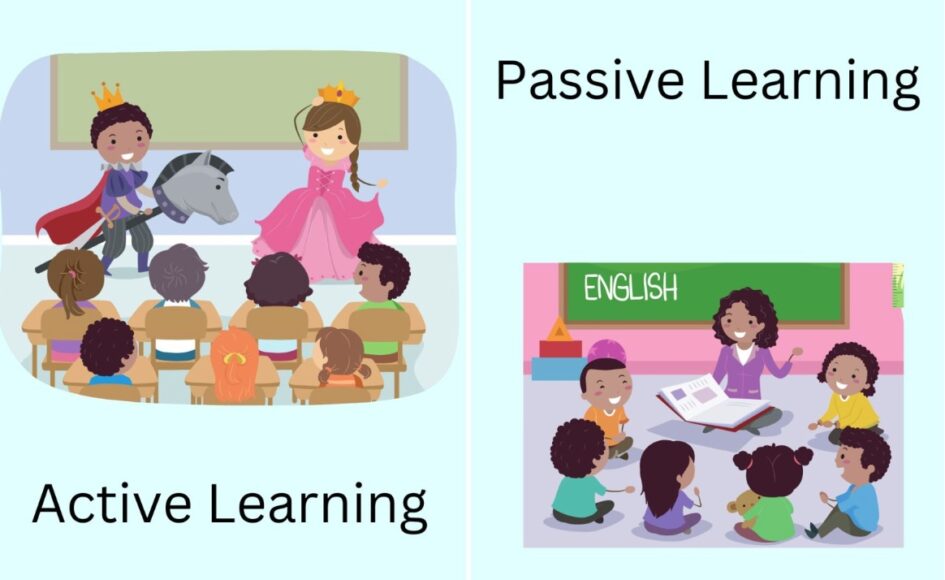
Photo by Priyanka Sonkushre
Introduction
I learned a lot this week about authentic, active, and engaging learning experiences. I’ve always known that it’s more important to do than to tell, but I haven’t always known how to make this happen. This week’s resources helped me better understand my past, present, and future experiences.
My experience with active/passive learning as an adult learner
Growing up, I was very used to passive learning. While things improved as education practices shifted, I still experienced a lot of passive learning in university. However, a few courses, including this one, clearly embed active learning practices throughout their design. In my Indigenous Education class, my professor front loads content with assigned videos, readings, podcasts, and other resources. We then journal weekly about what we think the main message is. Lectures often start with a story connected to the week’s theme, and storytelling continues throughout the slides. Students spend time in breakout rooms discussing what we have learned, relating our own stories and experiences to the content, speaking on how it will inform our practice going forward, and finish with sharing back to the group. Reflecting on this now, I can see that this structure aligns with the ICAP framework and the storytelling approach discussed in this module.
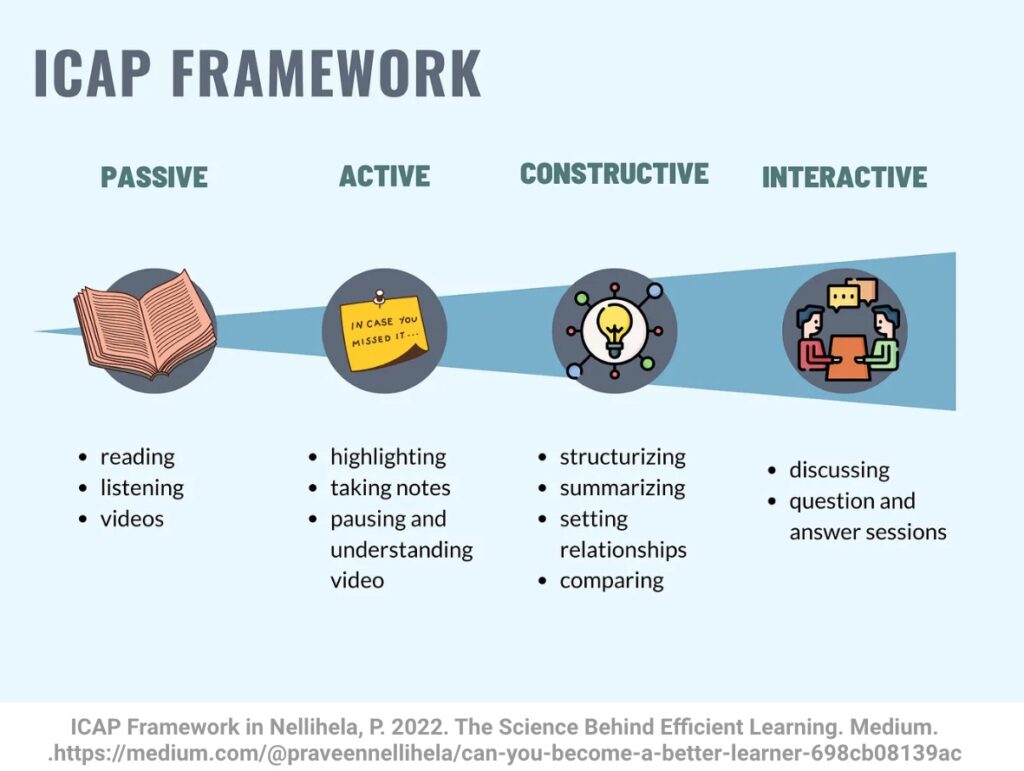
After the first lecture, I wasn’t sure how much I would learn from sharing stories, but I have learned more in this class than many others at UVic. This reflects Peter Reuell’s arguments in “Lessons of learning: Study shows students in ‘active learning’ classrooms learn more than they think” (2019). This also aligns with the idea that storytelling is a “method of transmitting learning and culture to the next generation, a practice as old as language itself” (Granchelli, n.d.).
My experience with active/passive learning as a teacher
A quote that stuck with me was “just because you covered it, that doesn’t mean they learned it” (Gonzalez, 2018). Gonzalez explains that many teachers move too quickly from direct instruction to independent practice and assessment, skipping guided practice and application. I fell victim to this in my practicum because I found it challenging coming up with engaging ideas. Similarly, I experienced time pressures, documentation demands, and high stakes testing requirements (2018). I realized, however, that my students were disengaged and struggling with assessment, making my efforts ineffective. Over the past year, I’ve improved at designing guided practice and application activities, but I still have a lot of learning to do. I especially like drama and art-based activities. These approaches align with the goals of storytelling by helping learners imagine experiences, build empathy, and deepen understanding (Granchelli, n.d.).
How my teaching will change
This week’s resources gave me practical strategies to better support active learning and understand when passive learning is appropriate. Gonzalez’s reading was especially helpful, as I now have concrete tools to use between instruction and assessment, including sorting (which we did at the beginning of this module through an interactive activity on the course cite), kinesthetic work, discussion, graphic representations, writing to learn, mini-projects, anticipation guides, quality note-taking, retrieval practice, and collaboration (2018). I also plan to incorporate more narrative tools, as they engage the senses and help to develop empathy and information retention (Granchelli, n.d.).
References
Chi, M. T. H., & Wylie, R. (2014). The ICAP Framework: Linking Cognitive Engagement to Active Learning Outcomes. Educational Psychologist, 49(4), 219–243. https://doi.org/10.1080/00461520.2014.965823
CODE Council of Ontario Drama and Dance Educators. (2025). Drama and Dance: At the Heart of Education. [Video]. https://www.youtube.com/watch?v=VH5yzcP_0rI
Gonzalez, J. (2018). To Learn, Students Need to DO Something. Cult of Pedagogy. https://www.cultofpedagogy.com/do-something/
Granchelli, A., & Watt, M. (2025). Storytelling. University of Victoria Educational Technology. https://edtechuvic.ca/edci337/2025/09/14/storytelling/
Nellihela, P. (2022). ICAP Framework. Medium. https://medium.com/@praveennellihela/can-you-become-a-better-learner-698cb08139ac
Reuelle, P. (2019). Lessons in learning: Study shows students in ‘active learning’ classrooms learn more than they think. The Harvard Gazette. https://news.harvard.edu/gazette/story/2019/09/study-shows-that-students-learn-more-when-taking-part-in-classrooms-that-employ-active-learning-strategies/
Sonkushre, P. (2022). Active vs Passive learning: What’s the difference? [Photograph]. Number Dyslexia. https://numberdyslexia.com/active-vs-passive-learning-whats-the-difference/
Leave a Reply
You must be logged in to post a comment.