Photo by Markus Spiske on Unsplash
Salmon Lifecycle Comic
Updated: February 19, 2026
Author: Brynn Birtwistle
Introduction
This educational comic was created to teach students about the salmon lifecycle in a way that won’t cognitively overload them and will keep them engaged.
I have chosen this topic because my pedagogy is based around teaching students that everything and everyone on earth is connected and must be treated with equal respect. I typically use the salmon lifecycle to reinforce this lesson, as salmon contribute so much to their ecosystem and are some of the most resilient creatures on earth. Students typically seem to feel much more connected and empathetic towards other creatures when they discover that salmon sacrifice themselves for their children’s survival.
Although there are many educational resources out there that teach students about the salmon lifecycle, I have never created my own and I know I will use it in the future. I wanted to implement everything I have learned so far in this course and create a story-based resource that wouldn’t be too cognitively demanding, would be accessible and engaging, and would aid in teaching the learning objectives.
THE PROCESS
Understand (Discover, Interpret, Specify)
DESCRIBE THE CHALLENGE:
Children need to learn about the salmon lifecycle as it teaches biodiversity in the local environment and how all living things are connected and deserve equal respect.
CONTEXT AND AUDIENCE:
This resource was designed for elementary aged students, specifically grades 2-4, as it aligns with many of the BC Curriculum learning goals for these grades. Most of these students have basic reading skills but varying comprehension levels. The typical student can focus for 10-15 minutes on engaging material and is developing the ability to make inferences from visual and text-based information. They may have diverse experiences with salmon. Some may have already learned about salmon or have experienced their spawning phase by living on the coast, while others may know very little and may only know them from grocery stores. Extreme cases include students with dyslexia who rely heavily on visual context clues, students with ADHD who benefit from chunked information and clear visual organization, and gifted students who can handle more complex concepts and extra challenges when presented accessibly.
Students need information presented through more than one method (visual and text-based) to reduce cognitive load and support germane load. They require words to be placed near corresponding images and presented simultaneously rather than sequentially. The comic minimizes extraneous cognitive load by eliminating decorative images that don’t support learning objectives, using simple panel layouts and imagery, and maintaining consistent and reliable text layout. Intrinsic cognitive load is managed by breaking the lifecycle into digestible chunks with one stage per comic box. By minimizing extraneous cognitive load and managing intrinsic cognitive load, germane cognitive load is supported and allows students to store information into their memory. The comic uses conversational language at a grade 2-3 reading level and vocabulary is supported through context and visuals.
The comic facilitates active learning by highlighting the learning goals and summative task before students read the comic. By knowing what is expected of them when they finish reading, they are more likely to know what to look for and how to achieve these goals. The comic also starts by activating prior knowledge for both students who have already learned about salmon and students who may have very little experience. The comic also aligns with many of the Web Content Accessibility Universal Design for Learning Guidelines, so it can be accessed and enjoyed by a wide range of students.
Students at this age are motivated by stories with clear protagonists facing challenges and achieving goals. The salmon’s journey from egg to spawning adult provides a natural story arc. It also works well to not only to provide students with the salmon lifecycle knowledge but also create connection and appreciation for other species, develop conservation values, and respond to themes of perseverance. Because students learn better from shorter segments, making the comic’s box-by-box and page-by-page structure ideal for building knowledge incrementally. They’re motivated by content that feels achievable, builds competency, and by seeing themselves in the learning. Behaviorally, they engage most when content connects to their prior knowledge, is in story form, is digestible and not too cognitively demanding, when they know what the learning goals are prior to engagement, and when they can actively process information through drawing and retelling the lifecycle (the summative learning task).
POV STATEMENT:
An elementary student needs to learn about the salmon lifecycle and how everything on earth is connected in a cognitively undemanding, digestible, engaging, and accessible way that builds on prior knowledge and sets achievable learning goals and tasks.
LEARNING OBJECTIVES:
- Students in grade 2-4 will be able to label and illustrate the stages of the salmon lifecycle after reading an educational comic about a salmon’s journey through the stages of her life.
- Students in grades 2-4 will be able to write, draw, or verbalize one other species salmon are connected to in their ecosystem after reading an educational comic about a salmon’s journey through the stages of her life.
- Students in grades 2-4 will be able to write or verbalize one way in which they appreciate salmon after reading an educational comic about a salmon’s journey through the stages of her life.
- Students in grades 2-4 will be able to share their summative work with a partner or small group after reading an educational comic and completing the tasks that follow it.
Plan (Ideate, Sketch, Elaborate)
IDEATION:
My brainstorming process included reviewing educational comics on the course website and online and deciding what I liked and what I didn’t based on design and cognitive demands. I also looked up “good vs. bad educational comics” and Google’s AI overview provided me with some places to start that related a lot to what we have learned so far in this course. I also reflected on my own experiences as a student who enjoyed certain comics and preferred learning with multimedia support. Additionally, I reflected on my experience as an educator and thought about which comics my students liked best and which lessons utilizing multimedia were most successful and why.
I then started drafting up my own comic ideas. I started by making the comic 7 panels reflecting the basic stages of the salmon lifecycle (egg, alevin, fry, parr, smolt, adult, and spawning adult). I tried to make the text very simple so the stages were obvious, and students wouldn’t be cognitively overloaded, but realized that students needed to emotionally connect more to this comic if I wanted them to gain respect for other species. I also realized I needed a minimum of 12 panels. So, I included the process from start to finish instead of minimizing it only to the stages by expanding each stage to a few boxes. By doing so, I was able to include emotions and struggles of the salmon along her journey, giving her more of a personal feel that kids would root for. However, after reflecting more about everything I have learned in this course, I realized I needed to connect to students’ prior knowledge and offer a task related to the learning objectives of the comic. So, I decided I would write the summative tasks and tips on how to be successful before the comic started so students know what to look for. I also decided to bold the stages in the text, so they were easy to distinguish. And finally, I decided to include a panel at the beginning that connected to students’ prior knowledge, considering that some students may have no experience and some may have lots. However, my most promising prototype came after this. I realized that I needed to include other species in the ecosystem if I wanted them to learn about biodiversity and how things are connected. So, I expanded the boxes more to show how the salmon, at every stage of their lifecycle, contribute to their ecosystem.
STORYBOARD AND SCRIPT:
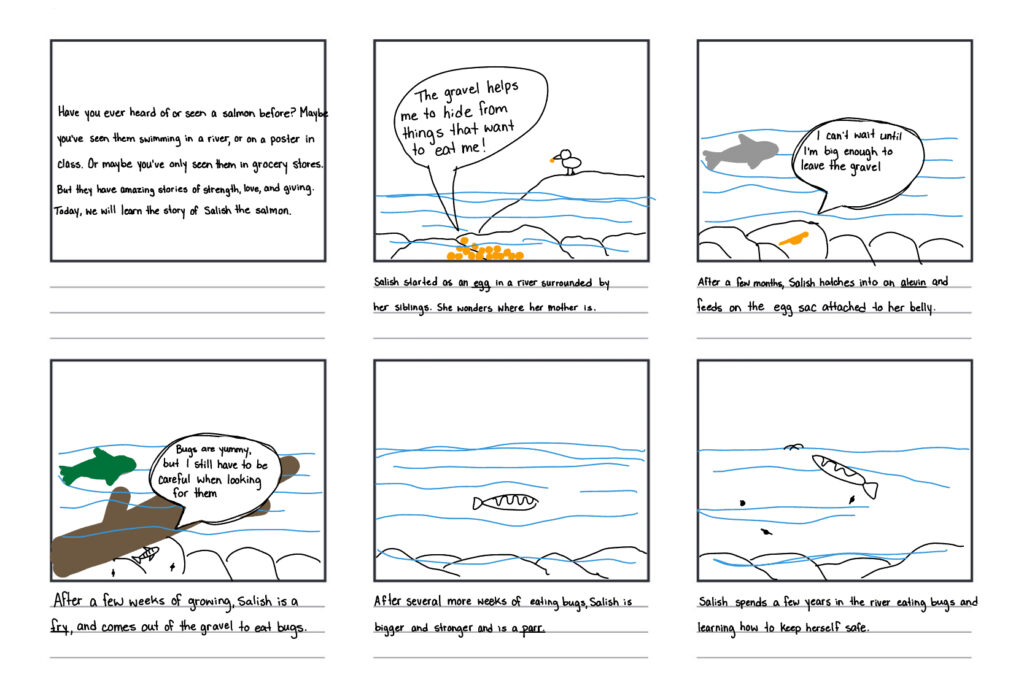
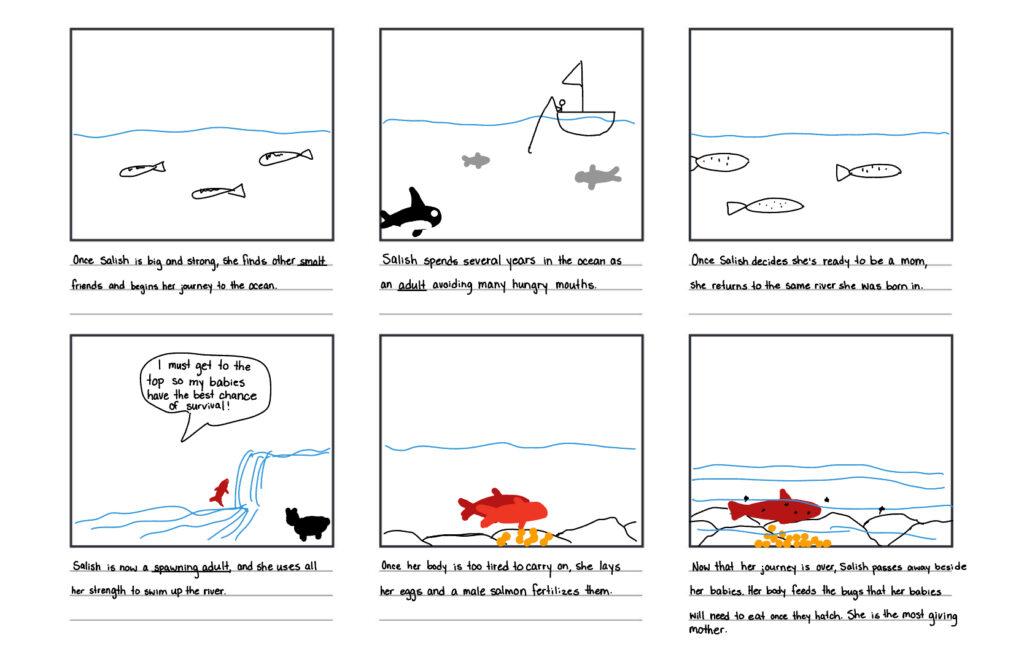
THEORY APPLIED:
- Cognitive load theory – the use of an educational comic allows us to use images and text to teach the same message. By using images, we can reduce the number of words used to describe something and manage students cognitive load. To make the text even more clear, we can also bold important words or phrases (the signaling principle) so students don’t have to use extra cognitive resources to decipher what’s important. In addition, by connecting to students’ prior knowledge and making learning goals and tasks known before the activity begins, students won’t have to use extra cognitive resources to make connections and know what’s needed to succeed.
- Dual coding theory – the use of an educational comic applies to the dual coding theory as students are able to process the images and text simultaneously through two different channels, allowing two avenues for understanding.
- Coherence principle – I avoided adding information that didn’t directly apply to the learning goals to manage cognitive load and allow for germane load.
- Personalization principle – I wrote the comic in comfortable and familiar language, so the comic is approachable and students are able to emotionally connect more.
- ICAP Framework – I tried to have students move through the stages of the ICAP Framework while attending to their comic and doing the summative tasks, starting with reading (passive), then taking notes (active), then structuring, summarizing, and setting relationships (constructive), then discussing and question and answer sessions (interactive).
- Merrill’s Principles of Instruction—learners are engaged in what I would consider to be a real-world problem (connecting to their environment and gaining respect for other living things). Existing knowledge is activated in the first comic box. New knowledge is demonstrated in the boxes that follow. New knowledge is applied by the learner when making their own lifecycle diagram and reflecting on one other species salmon are connected to. And new knowledge is integrated into the learner’s world when reflecting on one thing they appreciate or admire about salmon and sharing their learning with their peers. By following this structure, students are engaged in active learning that allows them to make meaning for themselves.
- Active Learning: Storytelling – By teaching this lesson through story, students can see and feel themselves in that situation and connect to the character more. In addition, I wanted to develop their empathy, memory, and “theory of mind” (Boulanger et al., 2009, as cited in Granchelli, 2025).
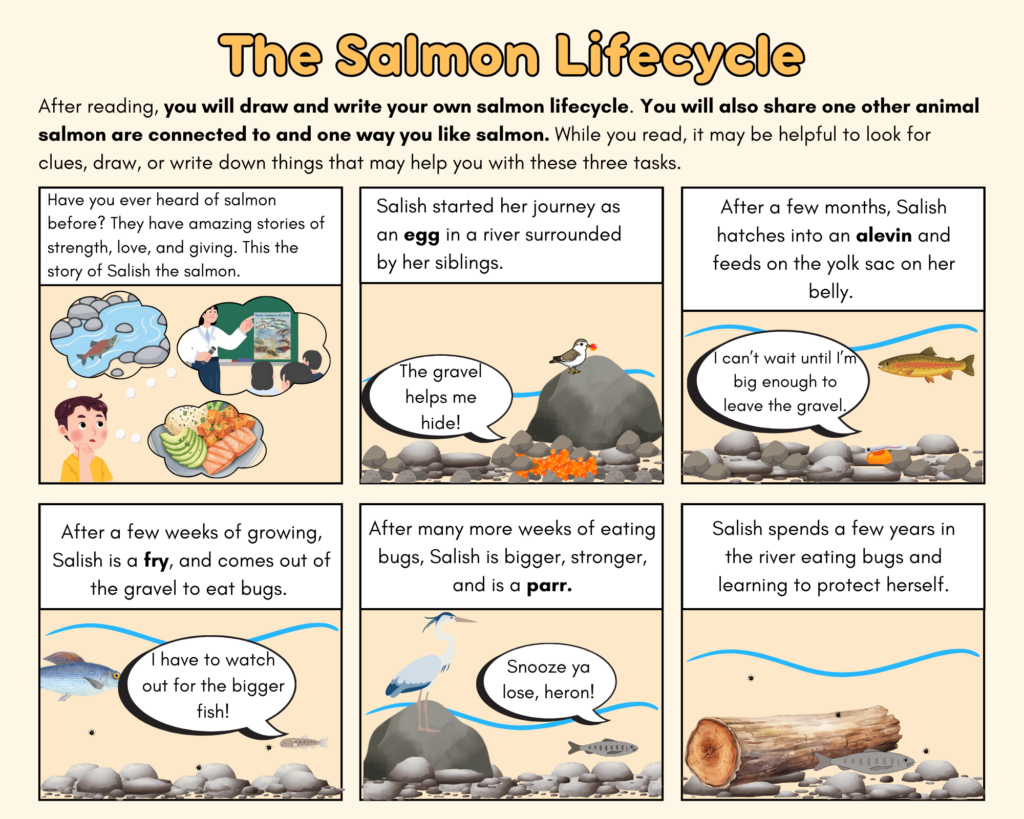
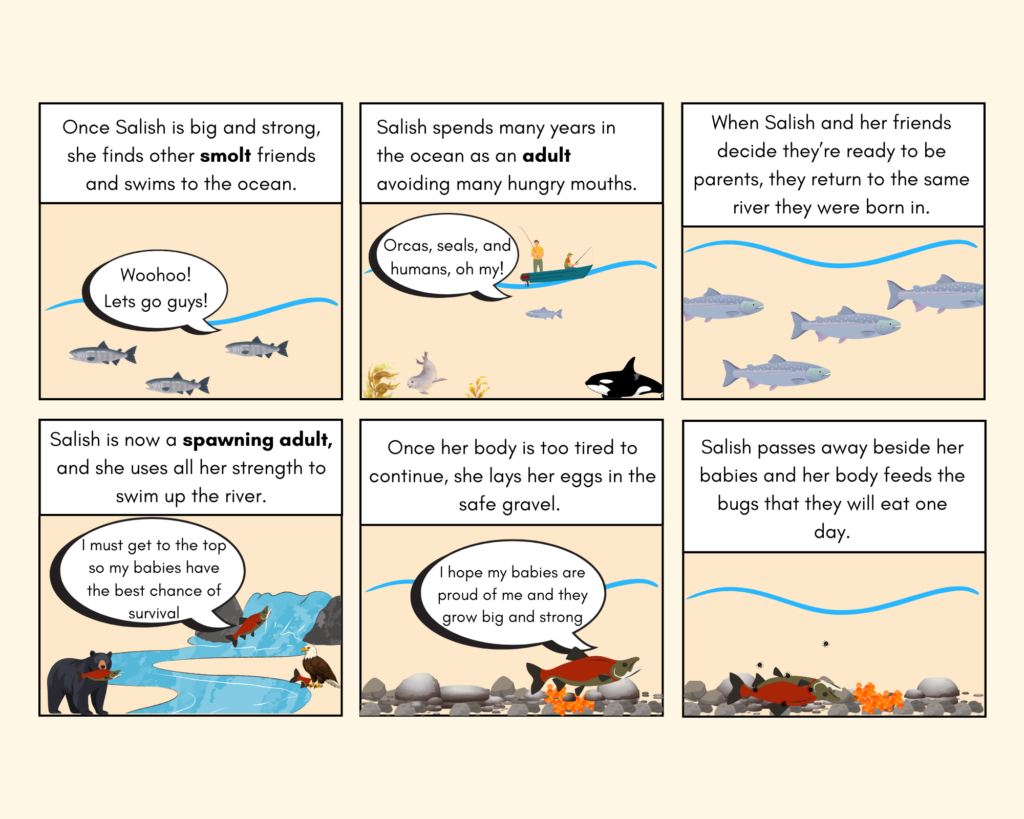
- Accessible Multimedia: Web Content Accessibility Features— For text, I made sure to use a simple font that’s easy to read, plain language and no unnecessary jargon, proper grammatical rules and upper and lower case appropriately, and ensured that there is enough contrast between the text colour and the background. For the comic, I included descriptive alt text on my blog and included the text from the comic in the alt text.
- Universal Design for Learning: Engagement
- Optimize choice and autonomy— students can write, draw, or verbalize to show their learning (when appropriate). Students can also work in a group or with a partner when sharing their work.
- Optimize relevance, value, and authenticity— the first box of the comic connects to students’ prior knowledge, no matter what experience they may have.
- Nurture joy and play— learning via a comic increases engagement.
- Clarify the meaning and purpose of goals— the summative tasks and and tips for how to be successful are written before the comic starts.
- Develop awareness of self and others; promote individual and collective reflection; foster collaboration, interdependence, collective learning, belonging and community— students are required to create their own salmon lifecycle and reflect on one way in which salmon are connected to other species and one way in which they appreciate salmon. Students then get together with a group or a partner to share their learning with one another.
- Cultivate empathy and restorative practices—This comic is designed to develop empathy towards other species.
- Universal Design for Learning: Representation
- Support multiple ways to perceive information—a comic is used to offer a second avenue for understanding text content (visual) and alt text is provided on the comic.
- Represent a diversity of perspectives and identities in authentic ways; connect prior knowledge to new learning—the first box of the panel connects to students’ prior knowledge, whatever that may be.
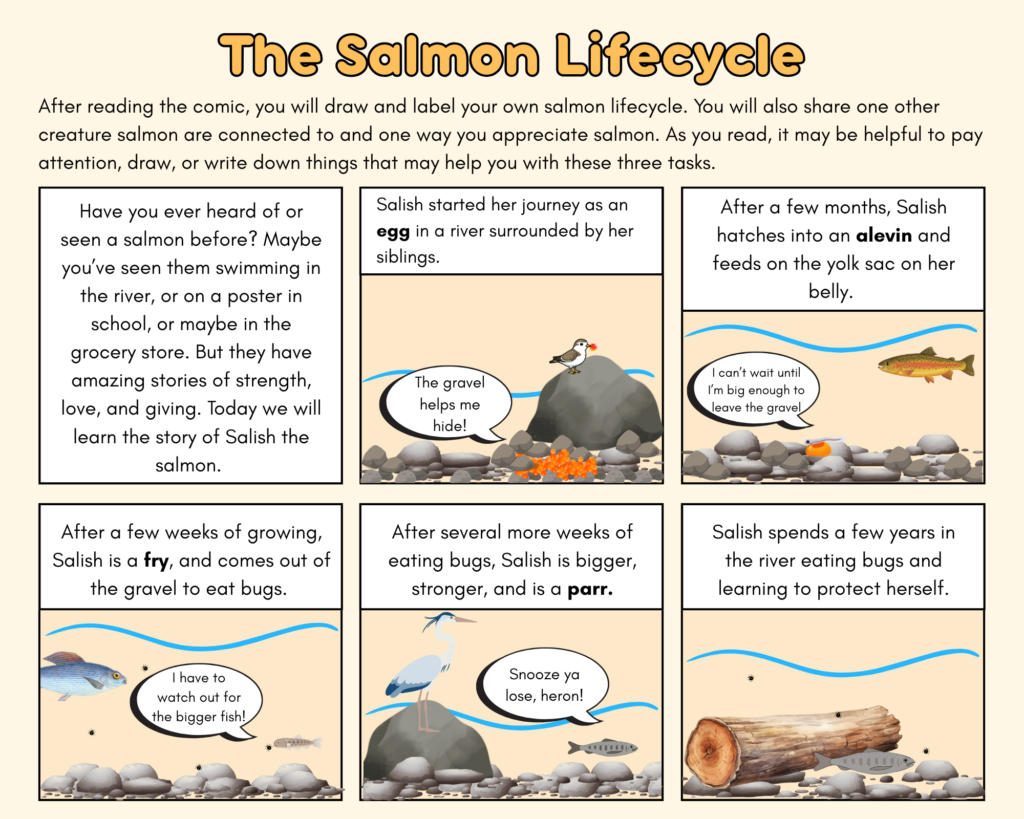
- Clarify vocabulary, symbols, and language structures; highlight and explore patterns, critical features, big ideas, and relationships—each stage of the lifecycle is bolded in the text so students know that the picture matches what the salmon should look like during that stage.
- Cultivate understanding and respect across language and dialects—by providing alt text on the comic, people can translate the comic into any language they need.
- Illustrate through multiple media—text and images are used in the comic to get the message across through two different avenues.
- Cultivate multiple ways of knowing and making meaning; maximize transfer and generalization—students have the option to write, draw, or verbalize to show their learning (when appropriate). There are three summative tasks with different objectives to secure information into long-term memory. Students share with one another to gain new knowledge and perspectives.
- Universal Design for Learning: Action and Expression
- Vary and honour the methods for response, navigation, and movement; use multiple media for communication—students have the option to write, draw, or verbalize to show their learning (when appropriate).
- Set meaningful goals—learning objectives and goals are listed before the comic so students can refer back to them and know what they need to do to meet those goals.
Prototype
PEER FEEDBACK:
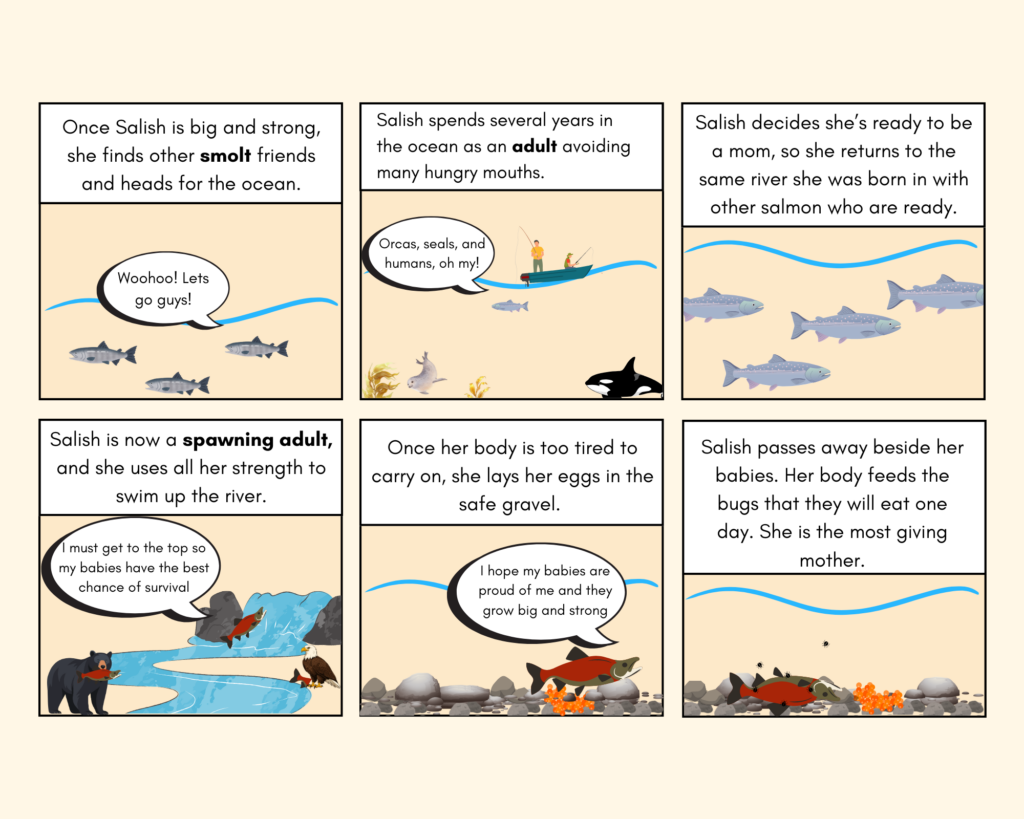
Both reviewers responded positively to the comic’s central narrative choice of following one character, Salish, through her entire lifecycle. Rather than feeling like a dry list of stages, this approach gives the content a story-like quality that young readers can follow and invest in. The emotional dialogue and speech bubbles were seen as particularly effective in bringing Salish to life and keeping the comic engaging. Reviewers also appreciated how seriously the audience analysis took accessibility, going beyond a general label of “elementary students” to consider learners with dyslexia or ADHD, which gave the design choices a clear and meaningful foundation.
The theory and planning section stood out to both reviewers as thorough. What made it work, they noted, was that each theory, framework, or principle was tied back to something actually present in the comic rather than just mentioned in passing. Specific design decisions also drew praise, including the bolding of new vocabulary terms, the placement of learning objectives before the comic begins, and the way prior knowledge is activated early and built upon across panels. The evolution of the storyboard to include more panels and information was also seen as a sign of genuine engagement with the design process.
On the feedback side, Parsa pointed to the text density in certain panels as something worth revisiting. Given that the audience includes students in grades 2–4 who are still developing their reading skills, some of the heavier text blocks, especially in the opening and closing panels, could be simplified or redistributed so the illustrations carry more weight. Peter also suggested making the ICAP peer-sharing activity more concrete by including specific prompts to help students move from independent to interactive engagement. Additionally, the small size of some speech bubble text was flagged as worth addressing, especially given how much care was already put into making the comic accessible in other ways.
Reflect and Refine
REFLECTION
Reflecting on both my own successes and those shared by my peers, I’m feeling pleased with how this comic came together. I think it aligns well with a grade 2–4 level and the intended learning objectives. It does a solid job of connecting to students’ prior knowledge and working through the stages of Merrill’s Principles of Instruction (2002), highlighting tasks beforehand and key terms throughout, reflecting the signalling principle from Mayer’s Cognitive Theory of Multimedia Learning (2001). The comic also connects to students emotionally by following a central narrative, in line with the personalization principle (Mayer, 2001), and incorporates many Web Content Accessibility Features (W3C, 2003) alongside UDL guidelines (CAST, 2024). The images are intentionally simple, supporting text comprehension without adding unnecessary cognitive load, drawing on both the Cognitive Load Theory (Sweller, 1988) and the Dual Coding Theory (Paivio,1971). Extraneous information was kept to a minimum, reflecting the coherence principle (Mayer, 2001), and the overall structure follows the flow of the ICAP Framework (Chi & Wylie, 2014). Altogether, the storytelling approach in a fun, engaging setting keeps students invested throughout.
After reviewing the initial draft, I made several changes. I bolded the tasks in the introduction so the three expectations were more clear, applying the signalling principle from Mayer’s Cognitive Theory of Multimedia Learning (2001). I also adjusted the language to be more age-appropriate for a grade 2–4 reading level, and increased the size of the voice bubbles and font throughout the comic, ensuring a minimum of 12-point text for readability. Finally, I reduced the overall amount of text to avoid cognitively overloading students, and added more images in the first panel to carry most of the communicative weight.
There were some issues raised that I would change if I had the chance. For example, I wish I could reduce the text use even more without losing important content and educational pieces. The other area I’d like to develop further relates to the ICAP Framework’s interactive stage (Chi & Wylie, 2014). For students to authentically engage at that level, they would need to share and discuss their work with a partner or group, with questions being encouraged throughout. Taking Peter’s advice, some useful discussion prompts could include: What was one thing you learned about the salmon lifecycle that you didn’t know before? What is one animal that is connected to salmon, and how are they connected? What is one thing you like about salmon? What was your favourite and least favourite part of this learning activity? These kinds of prompts would help scaffold meaningful peer dialogue and push the interactive stage beyond surface-level sharing.
Comics come with both strengths and limitations. On the limitations side, it can be difficult to include sufficient detail and context without introducing too much text and risking cognitive overload. While I did provide alt text in alignment with the Web Content Accessibility Guidelines (W3C, 2023), comics are inherently visual, which may pose challenges for students who struggle with sight. Additionally, some students may find the reading level difficult, and so supplementary reading support would need to be made available. That said, the strengths of this format are considerable. Children tend to find comics engaging and exciting, and given that students grow up in a highly visual culture, comics are a natural fit for visual learning (Yang, 2016). Students can also control the pace at which they consume the material and revisit sections as needed (Yang, 2016). The format aligns well with Allan Paivio’s Dual Coding Theory (1971), in that images and text work together to support understanding while being stored separately in memory, reinforcing dual learning pathways (Granchelli, 2025). This pairing is particularly beneficial for struggling readers and EAL students. Finally, the storytelling element taps into one of the oldest and most effective modes of knowledge transfer, allowing students to connect with characters and engage with the content in a way that feels natural and relatable.
FINAL ARTIFACT
References
CAST. (2024). The UDL Guidelines. https://udlguidelines.cast.org/
Granchelli, A. (2025, November 2). Accessible Multimedia. University of Victoria: Educational Technology. https://edtechuvic.ca/edci337/2025/11/02/accessible-multimedia/
Granchelli, A. (2025, October 19). Models of Active Learning. University of Victoria: Educational Technology. https://edtechuvic.ca/edci337/2025/10/19/models-of-active-learning/
Granchelli, A. (2025, September 14). Storytelling. University of Victoria: Educational Technology. https://edtechuvic.ca/edci337/2025/09/14/storytelling/
Granchelli, A. (2025, September 5). Theories of Multimedia Learning. University of Victoria: Educational Technology. https://edtechuvic.ca/edci337/2025/09/05/theories-of-multimedia-learning/
Spiske, M. (2021, December 15). a bunch of comics are spread out on a table. [Photograph]. Unsplash. https://unsplash.com/photos/a-bunch-of-comics-are-spread-out-on-a-table-lUgO0ozZ480?utm_source=unsplash&utm_medium=referral&utm_content=creditCopyText
TedxTalks. (2016, December 2). Why comics belong in the classroom | Gene Yang | TEDxManhattanBeach. [Video]. YouTube. https://www.youtube.com/watch?v=Oz4JqAJbxj0&t=299s
WC3. (2025, May 6). Web Content Accessibility Guidelines (WCAG) 2.1. https://www.w3.org/TR/WCAG21/
Leave a Reply
You must be logged in to post a comment.